|
|||
|
In this Update:
Remembering Operation Desert Storm 35 Years Later
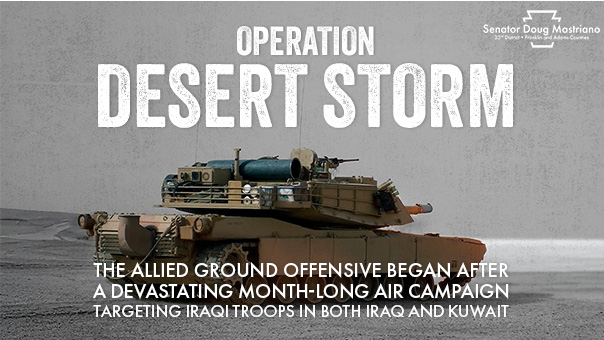
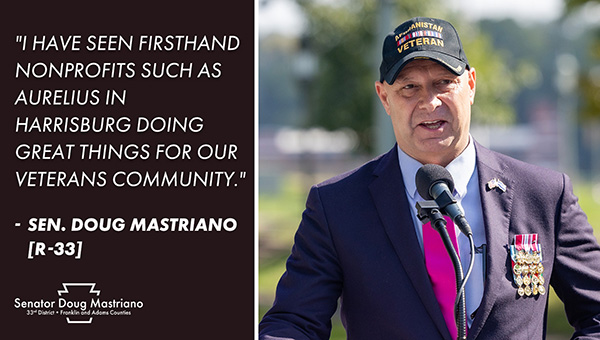
Feb. 25 marked 35 years since a Scud missile strike tragically claimed the lives of 13 brave Pennsylvanians from the Greensburg-based 14th Quartermaster Detachment. This week, we pause to honor all who served and sacrificed during Operation Desert Storm, confronting Saddam Hussein’s battle-hardened Iraqi Army in 1991. The conflict ignited on Aug. 2, 1990, when Iraq invaded and occupied Kuwait. President George H.W. Bush responded decisively, building a massive international coalition. By January 1991, nearly 700,000 U.S. troops — joined by 256,000 allied forces — stood ready. My higher headquarters, U.S. VII Corps (then stationed in Stuttgart, Germany), prepared grimly, ordering 10,000 body bags in expectation of heavy losses. The 2nd Armored Cavalry Regiment, my unit, was assigned the critical mission of spearheading the assault against Saddam’s elite Republican Guard. Back in Pennsylvania, an extraordinary outpouring of faith sustained us—and much of the credit belongs to my wife, Rebbie, a true Army wife through and through. As newlyweds facing the uncertainty of deployment, she rallied more than 20 churches — ultimately 24 praying specifically for my squadron — to lift us up daily in prayer. She organized a powerful prayer network across communities that interceded faithfully for our safety and success. Families across the commonwealth tied yellow ribbons to trees and homes as visible symbols of hope, solidarity and unwavering support. Those prayers and gestures reached us profoundly on the front lines, reminding us that we were not alone. After diplomatic efforts failed, the air campaign launched on Jan. 16, 1991 — a relentless 1,000-plus-hour bombardment that crippled Iraqi forces. Yet one persistent fear loomed: chemical weapons. Saddam had used them before against Iranians and Kurds, and prevailing winds typically blew south from Iraq into coalition positions, risking the spread of toxins deep into our lines. The ground offensive officially began on Feb. 24, 1991, though my regiment crossed into Iraq a day earlier. As our tanks advanced and dust devils swirled across the desert, something remarkable occurred. The prevailing winds — steady southward for months — suddenly shifted north. This unexpected change meant any Iraqi chemical strike would blow back onto their own forces. The winds held that direction until precisely 8 a.m. on Feb. 28 — the exact hour the ceasefire took effect. Many of us saw this as a direct answer to the prayers of those faithful churches and families back home. During the 100-hour ground war, coalition forces surged through southern Iraq and Kuwait. On Feb. 26, the Battle of 73 Easting unfolded — often called the last great tank battle of the 20th century. The 2nd Armored Cavalry led the charge against the Tawakalna Division of the Republican Guard and elements of the 12th and 52nd Armored Divisions. A fierce shamal windstorm swept in, blinding Iraqi forces while shielding ours, allowing us to press the attack decisively. Victory liberated Kuwait swiftly — but at significant cost to Pennsylvania. Thousands of our sons and daughters were deployed. The 14th Quartermaster Detachment suffered the single heaviest U.S. loss of the war when an Iraqi Scud missile struck their Dhahran barracks on Feb. 25, 1991, killing 13 and wounding 43. Their names endure: Spc. Steven E. Atherton, 26, Numine Robert Laurence Binyon’s 1914 poem captures their eternal legacy: “They shall grow not old, as we that are left grow old: May we forever honor the courage of Desert Storm veterans, the steadfast support of military families like my Rebbie and especially these Pennsylvanians who gave everything for liberty. Their sacrifice reminds us that freedom is never free — and in times of trial, faith and prayer can sustain a nation. Veterans TBI Assistance
I am introducing two measures aimed at improving care and expanding treatment options for Veterans living with traumatic brain injuries (TBI), a condition that affects thousands of service members following their military service. The first measure is a Senate Resolution urging Congress to pass the bipartisan Veterans Traumatic Brain Injury Adaptive Care Opportunities Nationwide (ACTION) Act (S. 3130), introduced by U.S. Senators Dave McCormick (R-PA) and Jacky Rosen (D-NV). This legislation would expand access to innovative neurorehabilitation programs for Veterans suffering from chronic mild traumatic brain injuries. The bill focuses on improving treatment approaches that address both the neurological and mental health impacts of TBI, including strategies that help prevent depression, isolation, and suicide among affected Veterans. The second measure would establish a Pennsylvania Traumatic Brain Injury Treatment Pilot Program to support facilities providing innovative and promising care for Veterans. Under the proposal, the Department of Military & Veterans Affairs, in consultation with the Department of Health, would award $150,000 annually for three years to three institutions located in the eastern, central, and western regions of the Commonwealth. This pilot program would help expand access to specialized care for Veterans while also studying patient outcomes to better understand which treatments are most effective. The goal is to ensure that Pennsylvania Veterans have greater access to cutting-edge care while helping inform future policies and programs that support their long-term health and recovery. Our Veterans have sacrificed greatly in service to our country, and we have a responsibility to ensure they have access to the highest quality care when they return home. Peace Through Strength: Why President Trump’s Action on Iran Was Necessary
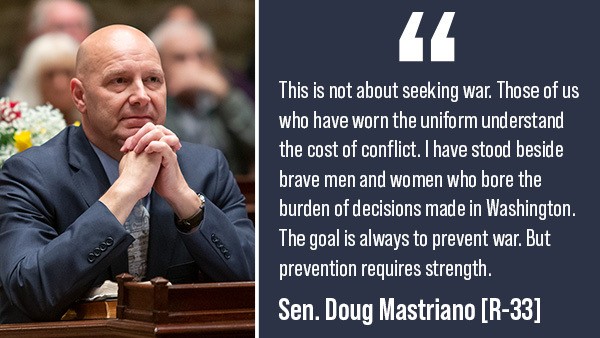
As a retired U.S. Army colonel who served more than three decades in uniform — including combat tours in Iraq and Afghanistan — I have seen firsthand what happens when America projects strength and what happens when it projects weakness. The world is watching. Our allies are watching. And our enemies are watching most of all. President Donald Trump’s decisive action against Iran was necessary. For more than four decades, the Islamic Republic of Iran has been the world’s leading state sponsor of terrorism. From the 1979 hostage crisis under President Jimmy Carter, to the bombing of our Marine barracks in Beirut, to the arming and training of militias that killed American soldiers in Iraq, the regime in Tehran has waged a sustained campaign against the United States and our allies. Under President Carter, America’s handling of the hostage crisis projected uncertainty. The images of blindfolded Americans held captive signaled to adversaries that the United States could be humiliated without consequence. That perception carried far beyond Iran. Decades later, the Obama administration pursued the Joint Comprehensive Plan of Action (JCPOA). While presented as a diplomatic breakthrough, the agreement released billions in sanctions relief without permanently dismantling Iran’s nuclear ambitions. Meanwhile, the regime expanded its regional aggression — funding Hezbollah, Hamas and militias across the Middle East — while continuing missile development. As a soldier who saw Iranian-backed explosive devices tear through American convoys, I cannot accept the premise that appeasement moderates a regime built on hostility to the West. Under President Joe Biden, a familiar pattern returned. Sanctions enforcement weakened. Frozen assets were made accessible. Proxy attacks against U.S. forces and our allies increased. Regional instability grew. The lesson is consistent: when the United States signals retreat, the ayatollahs advance. Diplomacy without credible force behind it is not strategy, it is wishful thinking. President Trump understood a fundamental truth: peace is secured not by hoping adversaries will change, but by convincing them they must. His administration’s maximum pressure campaign constrained Iran’s economy and limited its ability to finance terrorism. More importantly, it restored deterrence. When American red lines were crossed, there were consequences. Critics argue that force risks escalation. That is true. But inaction carries risk as well — often greater risk. Failing to respond to aggression teaches adversaries that America lacks resolve. Over time, that perception invites larger and more dangerous conflicts. Here in Pennsylvania, Gov. Josh Shapiro criticized President Trump’s actions as destabilizing. Yet this is the same governor who signed artillery shells destined for Ukraine. One cannot celebrate the tools of war in one context and condemn their strategic use in another when deterrence requires resolve. Foreign policy cannot be partisan. It must be principled. Leadership demands clarity and consistency. Our adversaries study our words and measure our actions. Mixed signals are dangerous. Strength and diplomacy are not opposites — they are partners. President Ronald Reagan demonstrated this during the Cold War. President Trump applied the same principle: aggression will meet resolve. This is not about seeking war. Those of us who have worn the uniform understand the cost of conflict. I have stood beside brave men and women who bore the burden of decisions made in Washington. The goal is always to prevent war. But prevention requires strength. Iran’s regime has shown repeatedly that it interprets concession as weakness. President Trump’s action delivered a different message: the United States will defend its people, its allies and its interests. The stakes extend beyond the Middle East. China and Russia are watching closely. If America falters in confronting Tehran, challenges will multiply elsewhere. Peace through strength is not a slogan — it is a doctrine grounded in history and hard experience. I learned that in uniform. President Trump applied it in office. For the security of our nation and the stability of our allies, it was the right course. Strengthening Pennsylvania’s EMS System
In the near future, I will introduce legislation to strengthen Pennsylvania’s Emergency Medical Services system and ensure our EMS providers receive the support and recognition they deserve. Across the Commonwealth, EMS agencies continue to struggle with staffing shortages, administrative burdens, and a disciplinary system that too often leaves them without a fair path to resolution. At the same time, the Bureau of EMS has faced persistent challenges gaining the attention and resources it needs within the Department of Health. This legislation takes three important steps within Title 35 (Health & Safety): Recognizes the importance of EMS leadership by elevating the Bureau of EMS Director to Deputy Secretary status, ensuring EMS finally has a strong voice at the highest levels of the Department of Health. Reforms the disciplinary process by establishing a fair and transparent appeals process for EMS agencies, giving providers due process while maintaining high standards of care. Cuts red tape by creating a clear, consistent pathway for Emergency Medical Responders and Emergency Medical Technicians with lapsed certifications; permitting EMS Vehicle Operators to be trained in-person and on-site or in a digital format – and remove their continuing education credit requirement; removing the requirement that an Advanced Life Support ambulance be staffed with an EMS Vehicle Operator; and establishing an exception for staffing requirements when in a situation with limited EMS resources. Our EMS professionals are the backbone of emergency response in every community. They deserve a system – top/down — that works as hard for them as they work for us. This legislation is a meaningful step toward stability, accountability, and respect for the lifesaving work they perform every day. Future Legislation to Upgrade the Fire & EMS Grant Program
In the near future, I plan to reintroduce several components of previous Senate Bill 1099 to make important technical improvements to Pennsylvania’s Fire and EMS Grant Program. These updates are designed to modernize the program, streamline administration, and strengthen communication with local fire companies. Key changes include:
These updates aim to ensure the grant program remains effective, accessible, and aligned with the needs of our fire and EMS community. Throwback
Here I am with local German kids during REFORGER 1988—the largest of the Return of Forces to Germany exercises—when a quarter of a million American troops surged into Germany to rehearse the defense of Western Europe against a potential Soviet invasion. Whenever we were in the field, the local kids would inevitably wander over, curious and smiling, drawn to the spectacle of tanks, trucks, and camouflage. They always asked for the prized brown packets—our MREs. To them, they were exotic treasures from America. To us, they were just another meal in the mud. Without fail, they’d come ready to bargain, trading fresh bread from their mothers’ kitchens or thick slabs of German chocolate in exchange. It was Cold War soldiering by day—and simple, human connection by afternoon. Senate Budget Hearings Examine Spending Details, Transportation Issues and More
The Senate Appropriations Committee wrapped up two weeks of public hearings on Gov. Josh Shapiro’s $53.3 billion proposed state budget, which would increase spending by $2.7 billion, or 5.4%. At the hearings with the Budget Office and Department of Revenue, committee members raised concerns about the level of spending, inefficiencies in state government and the potential consequences of irresponsible budgeting. The Pennsylvania Department of Transportation’s questionable management of public transit and infrastructure projects was the focus of its hearing with the committee. Lawmakers pressed the agency not only on project oversight but also on the growth of funding held in certain accounts and the lack of transparency surrounding how those dollars are being spent. The Public Utility Commission oversees more than 8,000 entities which provide utility services across the state. Committee members raised concerns that Gov. Shapiro’s approach to energy is leading to higher costs for Pennsylvania consumers, while subsidizing lower energy prices in other states in the region. Committee members explored growing prison costs at the Department of Corrections hearing. The budget would increase spending for the department by $142 million. The 4.4% increase comes despite the fact the department is closing two correctional facilities and is 6,000 beds under capacity for the remaining facilities. Committee members focused on how State System of Higher Education universities are working to improve enrollment and efficiency. The panel took testimony from the presidents of Millersville, East Stroudsburg and West Chester universities and Indiana University of Pennsylvania. You can find complete recaps and videos of each hearing here. Bill to Ease Shortage in Long-Term Care Workers Approved by Senate
To help alleviate Pennsylvania’s serious shortage of long-term care workers, the Senate approved legislation to allow high school juniors and seniors to earn graduation credit by working or volunteering in these settings so they can consider a career in this crucial field. Health care leaders and senior advocates strongly support Senate Bill 116 because while Pennsylvania’s population over the age of 65 is expected to nearly double by 2040, the number of long-term care professionals declined by 14% from 2019 to 2022. This bill is part of a bipartisan package aimed at strengthening the long-term care workforce. Along with Senate Bill 114 and Senate Bill 115, it awaits action in the House of Representatives. Family Caregivers Can Find Help Through State Support Program
Caring for a loved one is rewarding but also challenging. If you or someone you know could use some help, the state Caregiver Support Program could be the answer. The state Caregiver Support Program provides relief through respite care, education and financial assistance for eligible unpaid caregivers. Each caregiver is assigned a care manager who will come to the home, conduct a comprehensive assessment of the needs of the caregiver, provide support and work with them to develop a care plan. Find out more about eligibility and how to apply, and find other caregiver resources, from the Department of Aging. Online Filing Option Available for PA Personal Income Taxes
If you’re working on your taxes, keep in mind you can file your Pennsylvania Personal Income Tax return online for free through the myPATH portal. It includes automatic calculators, instant confirmation and secure payment options. You can access many features directly from the myPATH homepage without needing to create a username or password. Additional options are offered exclusively to users who opt to create an account. Learn more from the state Department of Revenue. Supporting Veteran-Owned Businesses
Pennsylvania is one of the top states in the nation for veteran-owned small businesses and Invest in Veterans Week (March 1-7) helps focus attention on these patriotic entrepreneurs. These men and women served our nation and are now providing jobs and economic vitality in our communities. Please keep an eye out for veteran-owned businesses in our area. If you’re a veteran looking to start or expand a business, you can find state and federal resources here.
For anyone who hasn’t already signed up to receive e-newsletters, you can get on the e-newsletter mailing list here. |
|||
|
|||


Want to change how you receive these emails? 2026 © Senate of Pennsylvania | https://senatormastriano.com | Privacy Policy |